Reducing Your Load: The First Step to Feeling Good on TRT Is Doing Less.
Before you add one more thing to the stack, you need to stop the stuff that's quietly draining you dry.

If you read manifesto Beyond the Dose, you already know the punchline. Your labs look fine. Your protocol is probably fine. The reason you feel like shit on TRT isn’t your dose or your injection frequency or your E2-to-free-T ratio.
It's your biology.
The body receiving the testosterone is too depleted to do anything useful with it.
Fuck. So now what?
This article kicks off a three-part deep-dive into exactly that. The 40/40/20 model in my Beyond the Dose article broke the problem into three pieces: load, buffer, and capacity. This series unpacks each one in depth.
Part one (this article): Load. Stop the bleeding. Identify what’s draining your system and cut it.
Part two: Buffer. Rebuild the biological reserves load reduction has stopped depleting.
Part three: Capacity. Expand what your system can actually handle, so TRT can finally do what it’s supposed to.
They build on each other in that order. Skip ahead and you’ll waste your time.
If you’re like most guys, your instinct right now is probably to start building.
Add another practice.
Try more supplements.
Start a breathing protocol.
Stack something new on top of whatever else you’re already doing.
That’s the default move when something isn’t working - try harder, do more, add more.
But if you’ve already tried the obvious fixes and you’re spinning your wheels trying to “fix your TRT”, that instinct is wrong. And it’s exactly what is keeping you stuck.
The first move isn’t to add more. It’s to subtract. Before you can rebuild your buffer, before you can expand your capacity, you have to stop the bleeding. You have to figure out what’s been draining your system and reduce it or remove it entirely.
“Do less” is about the last thing you want to hear right now. You’re already frustrated. You’ve already spent months or years trying to get dialed in. Telling you to pull back feels like telling you to give up.
It’s not. It’s actually the most clever and strategic play you can make right now.
In this article I’m going to break down what “load” actually means, why most of what’s draining you doesn’t look like a stressor, and the specific things to start cutting this week.
What "Load" Actually Means
Not “stress” in the vague, hand-wavy sense your doctor uses when he tells you to relax more while simultaneously billing you $200 for a 7-minute appointment.
Load is everything your system has to process in a given day. Every input, every stressor, every demand on your biology — whether you think of it as a stressor or not.
The argument with your wife that “wasn’t a big deal.”
The supplement stack you take every morning.
The three hours you spent on Reddit last night reading about other guys’ protocols.
The gut inflammation from that food sensitivity you don’t even know you have.
Blue light. Caffeine. The news cycle. Air quality. Your commute.
Plus the historical load your system is still carrying — unmet childhood needs, the asshole stepdad, the ex who shafted you. You know the stuff I’m talking about.
Your body doesn’t separate “good stress” from “bad stress” at the processing level. It all costs energy to manage. It all draws from the same buffer.
When total incoming load exceeds your capacity, the system starts triaging. It drops anything not immediately critical for keeping you alive. Recovery tanks. Sleep goes to shit. Inflammation creeps up. Digestion gets weird. Your nervous system locks into fight or flight.
Hormonal signalling — including everything TRT is trying to do for you — gets deprioritised, because your body is too busy surviving to bother with thriving.
Here’s why this matters more than anything else you could be doing right now:
Your body runs on ATP. It’s the molecular currency that powers every repair process, every immune response, every neurotransmitter conversion, every hormonal cascade. When your system is under constant load, it’s burning ATP just to keep the lights on. There’s nothing left for repair, adaptation, or growth.
This is why you feel exhausted after eight hours of sleep. Why your recovery is garbage despite eating clean. Why nothing on paper explains how you actually feel.
Now add TRT on top of that. Exogenous testosterone is activating. It raises sympathetic tone, modulates catecholamine signalling, and increases total metabolic demand. For a guy with capacity to spare, that activation feels like drive and energy. For a guy whose system is already maxed out, it’s just one more load on a system that can’t handle what it already had.
You cannot out-supplement a draining system. You cannot optimise your E2-to-free-T ratio into capacity. You cannot micro-adjust your injection frequency into wellness. You cannot Wim Hof your nervous system into regulation while 37 other stressors are hammering it all day.
Load reduction isn’t optional. It’s the prerequisite for everything else.
The Discipline Trap
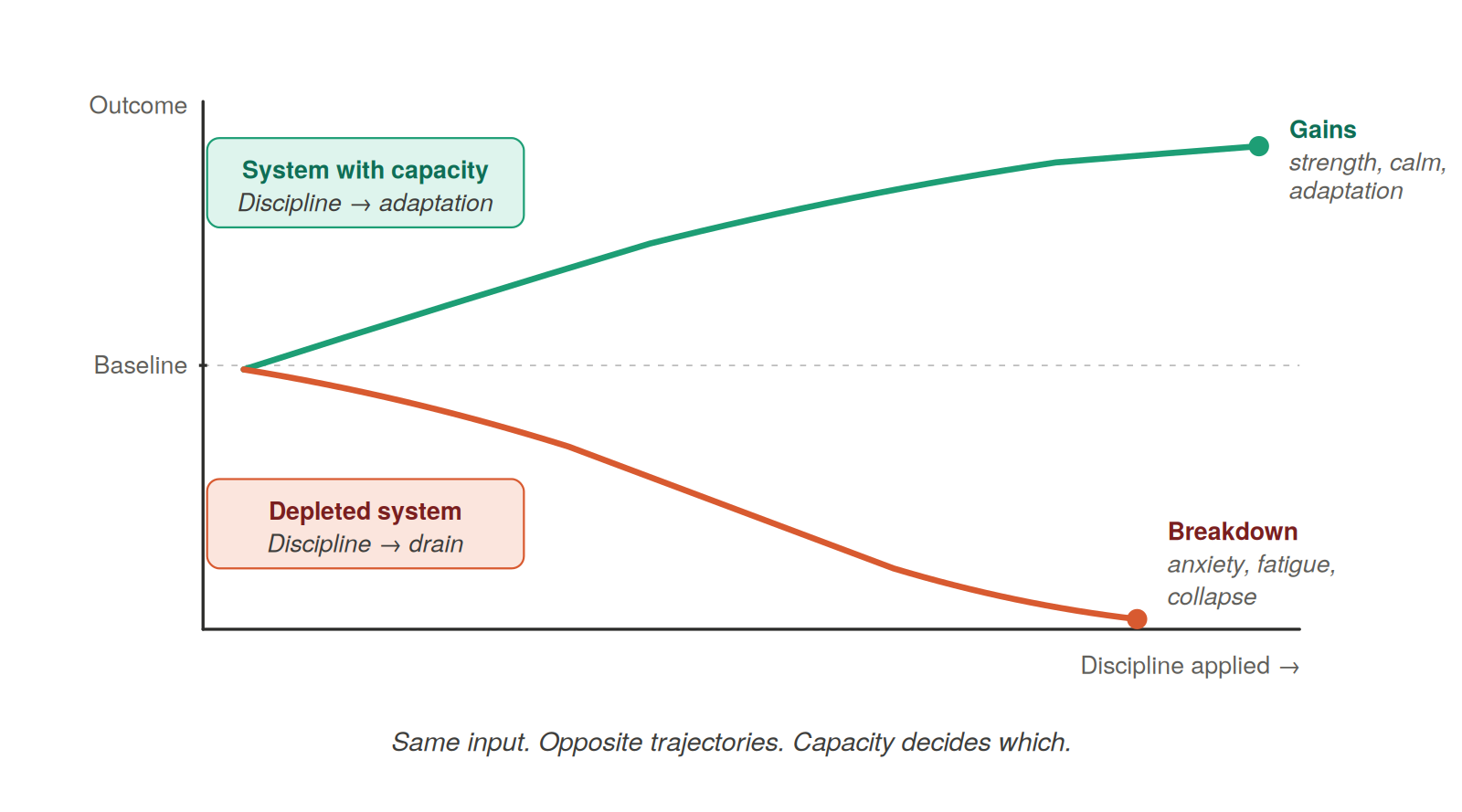
Before we get into the actual drains, here’s the part that stings.
The guys who struggle most with this are almost always the most disciplined. (I get it. This was me too. Still is sometimes.)
They train hardest. Diet strictest. Research most obsessively. Push themselves most relentlessly. That’s their identity. That’s who they are. The guy who does the work.
And it’s exactly why they’re depleted.
Discipline applied to a depleted system doesn’t produce results. It produces breakdown. The harder you push, the further behind you fall. The more you optimise, the worse you feel. And the whole time, it feels like virtue. It feels like you’re doing the right thing.
There’s nothing virtuous about running a system into the ground.
The hardest part of this process for most guys isn’t the work. It’s the restraint. Cutting training sessions feels like giving up. Dropping supplements feels like going backwards. Eating more carbs is for women. Sleeping more feels lazy.
Knowing what to cut and in what order - without cratering your training, your relationships, or your sanity - is the work The Capacity Code is built around. Eight weeks, structured, application only.
Or keep reading: the next section is the long list of what's actually draining you.
What’s Actually Draining You
This is where it gets interesting, because a lot of what’s draining your system doesn’t look like a stressor. Some of it looks like healthy habits. Some of it looks like coping. Some of it is so embedded in your daily routine you’d never think to question it.
Pay attention to the ones that make you uncomfortable. Those are usually the ones that matter most.
Caffeine.
Nobody wants to hear this. I moved to Europe a few years ago and I enjoy an espresso in a sunny cafe on a Saturday morning as much as anyone. So I get it.
But that pre-workout and three cups of coffee aren’t “energy.” They’re a direct assault on your sympathetic nervous system.
Caffeine blocks adenosine receptors so your brain can’t register how tired it actually is, and it stimulates adrenaline and cortisol release on top of whatever your body was already producing.
For a guy with a full tank, this isn’t a big deal. For a guy whose nervous system is already running hot, it’s throwing gasoline on a fire.
You’re not getting energy from caffeine. You’re borrowing it from a bank account that’s already overdrawn.
And the kicker: caffeine has a half-life of about five hours. That 2pm coffee is still rattling around your system at 8pm. Still elevating cortisol at midnight1. And you’re lying in bed wondering why you can’t sleep. Come on.
I’ve had more clients than I can count cut caffeine and discover, usually within two or three weeks, that the “baseline anxiety” they’d been carrying for years wasn’t their personality. It was their nervous system being chronically hammered by a stimulant they’d long stopped feeling.
The insomnia that they’d written off as “just how I am now” eases up. The pounding heart the day after your injection drops in intensity.
The wired-but-tired thing quiets down. It’s never the whole story, but it’s sometimes enough of a shift where TRT already feels less like it’s adding fuel to the flames.
These guys aren’t special. They just finally gave their system enough breathing room to show them what was actually going on.
Training volume.
Exercise is a stressor. A good one when your system can absorb it and respond with adaptation. A destructive one when it can’t.
The guy hammering six sessions a week with two-hour workouts who “can’t understand why his recovery is garbage” isn’t under-recovering.
He’s beating the shit out of a system that has no resources left to convert any of that stimulus into growth. And because he feels terrible, he trains harder, because that’s what disciplined guys do when something isn’t working.
In many areas of life, that’s admirable. But this is the fitness equivalent of flooring the accelerator when the engine is overheating.
I’ve watched clients cut from six sessions to three and gain strength while their anxiety dropped.
This isn’t a coincidence. Their system finally had enough capacity to actually respond to the training instead of just surviving it.
Your diet.
Forget “clean eating” for a minute. The thing wrecking depleted guys isn’t usually the quality of their food. It’s that their gut can’t handle what they’re putting in it.
Two reasons for this:
Hidden sensitivities that won’t show up on any test. Histamines, oxalates, salicylates, FODMAPs, lectins, sulfites, amines.
Most allergy and sensitivity panels miss these entirely because they’re not classical IgE allergies. They’re load reactions.
Your gut is inflamed, your nervous system is wired, and certain compounds in otherwise healthy foods tip the system over.
Spinach, tomatoes, avocado, leftovers, bone broth, fermented foods, nuts. All technically “clean.” All potentially problematic when you’re depleted.
And on top of that: a dysregulated nervous system will sometimes react to foods that pose no actual problem. Pure pattern-matching from a hypervigilant system. The fix for that isn’t another elimination — it’s regulating the nervous system underneath.
Meal complexity itself is load.
Your gut handling chicken and rice is one biological problem. Your gut handling a 15-ingredient meal with three protein sources, a sauce, vegetables, garnishes, and dessert is fifteen biological problems running in parallel.
Each ingredient adds variables. Variables add fermentation. Fermentation adds endotoxin. Endotoxin adds inflammation. Inflammation adds load.
You can eat the cleanest meal on paper and still feel poisoned afterward — bloated, foggy, fatigued, anxious — because your system is processing too many inputs at once.
If you’re foggy after meals, crashing in the afternoon, reacting to “healthy” foods, or just feel inflamed all the time, your diet might be quietly draining you even when it looks great on paper.
Your supplement stack.
Fifteen capsules every morning isn’t optimisation. It’s polypharmacy with a health food store label.
Every supplement has to be processed by your liver and kidneys.
Every one interacts with your biochemistry in ways that get genuinely unpredictable when you’re stacking five, ten or more.
Some are competing for absorption.
Some are doing literally nothing because you don’t have the deficiency they’re addressing.
Some (especially high-dose adaptogens like ashwagandha) are actively pushing hormonal and neurotransmitter systems in directions your depleted body can’t handle.
I’ve had clients strip their stack to two or three essentials and feel noticeably better within a week.
I experienced this myself during my own recovery journey: At one time I was spending nearly $400 a month on a huge stack of supps I thought were holding me together. Out of frustration I stopped everything but pregnenolone and felt an improvement within a couple days.
There’s nothing inherently wrong with supps. I still use them myself and recommend them to clients for specific use cases. But as a source of allostatic load, less is usually more.
Alcohol.
Even “moderate” amounts.
A couple of beers on Friday night doesn’t just take the edge off. It disrupts your sleep architecture for the entire night2, impairs neurosteroid production, increases estrogen conversion, spikes inflammatory markers, and taxes your liver’s detox capacity.
For a guy with a full buffer, the system absorbs this and moves on. For a guy who’s already depleted, it’s a two-day (or more) setback disguised as relaxation.
If you’re struggling on TRT and having more than 1-2 standard drinks a week, you’re bleeding capacity you cannot afford.
Cannabis.
Next to caffeine, this is the one I get the most push back on from clients who are often convinced they need it to sleep or manage their anxiety. And I get it. I took more than my fair share of bong rips back in the day, and justified it as “medicinal”.
But here’s what it’s actually doing:
Suppressing REM sleep: where your brain does its most critical repair and memory consolidation.
Blunting the cortisol awakening response: so you wake up flat and unrested.
Elevating prolactin: which brings its own set of downstream problems (more on that below)3.
Downregulating your endocannabinoid system over time, so you need more just to feel baseline.
If you’re using weed to manage symptoms that TRT was supposed to fix, you’re not solving the problem. You’re masking it while creating new ones.
That's the obvious stuff. Now let’s also look at some sources of load most guys miss entirely:
Rumination.
This one’s sneaky because it disguises itself as productivity or problem-solving.
You’re not “staying informed.” You’re not “being proactive about your health.” You’re stuck in a neurological loop that activates the same stress pathways as a physical threat.
Every time you open Reddit to read another thread about someone else’s protocol. Every time you spend an hour on ChatGPT asking it to analyse your labs from eight different angles. Every time you re-check your bloodwork looking for the number that’ll explain everything. Every time you Google whether your E2 is optimal.
Your nervous system registers all of it as threat-scanning. It dumps cortisol. It raises sympathetic tone. It keeps you locked in a vigilant state that blocks recovery.
The guy spending two hours a night in TRT forums is not better informed than the guy spending zero. He’s more anxious.
Psychological stress you’ve normalised.
The job you’re hanging onto despite it making you miserable. The financial pressure that hums in the background every waking moment. The unresolved conflict with your brother that you’ve “moved past” but think about daily. The performance review you’ve been dreading for three weeks.
This stuff isn’t separate from your physical health. Psychological stress activates the exact same biological pathways as physical injury. Cortisol. Catecholamines. Oxidative stress. Inflammatory signalling.
Your body doesn’t distinguish between “my boss is an asshole” and “a bear is chasing me.” The hormonal response is identical. And when it’s chronic, it drains your buffer every single day without you even noticing.
Your relationship.
This one can be difficult to look at.
But a relationship that’s constantly draining you — whether it’s active conflict, walking on eggshells, or just that low-grade tension of being with someone and feeling completely alone — is one of the most potent sources of sustained nervous system load there is.
It’s not a one-off stressor. It’s the background hum of your entire life. You wake up in it. You go to bed in it. Your nervous system never gets a break because the source of the stress is lying next to you.
And it feeds on itself. When you’re depleted and reactive, you’re harder to live with. Your partner responds to that. The tension increases. You get more depleted. It’s a loop.
TRT can make it worse, because the activation that should come out as confidence and presence shows up as irritability and emotional volatility instead.
I’m not saying your relationship is the problem. I’m saying if it’s a source of chronic unresolved tension, it’s a massive line item in your load budget whether you want to acknowledge it or not.
I’ve worked with clients who identified this as the single biggest drain on their system. Bigger than training, supplements, and diet combined.
Porn and excessive ejaculation.
I’m not making a moral argument here. I’m making a neurological one.
Every orgasm produces a prolactin spike. In a healthy, well-regulated system, prolactin rises, does its job, and clears within hours. In a dysregulated system (the one you’re in if you’re reading this) clearance slows, and prolactin stays elevated longer than it should.
Here’s why that matters: prolactin and dopamine have an inverse relationship. Elevated prolactin suppresses dopaminergic tone.
Which blunts motivation, drive, libido, and general zest for life. Exactly the things you went on TRT to get back.
On top of that, frequent high-intensity dopamine spikes from porn create tolerance patterns that further blunt your reward system, compounding the problem from the other direction.
This isn’t a NoFap sermon. It’s a capacity argument. If your budget is in the red, this is another withdrawal you can’t afford right now.
Sensory overload.
Almost nobody thinks about this one.
Constant phone pings. Open-plan offices. Background noise all day. Blue light from screens until midnight. News designed to keep you in a low-grade state of threat. Rush hour traffic.
Individually, each one is small. Stack them across a 16-hour day and they become a constant drain on a system that’s begging for a break.
That feeling of being overstimulated in busy environments is not weakness. That’s your system telling you it has no capacity left to process one more input.
That’s not everything, just a start. But if you’re honest with yourself, you probably just identified four or five things you’d never thought of as “load” that have been quietly bleeding you dry for months.
Where to Start
You don’t need to overhaul your life by Monday. That would just be another form of load stacking. Here’s how to start without turning this into another optimisation project.
Pick three or four of these to implement over the next two weeks. Not all of them at once. Stack a couple of the easy ones (caffeine, supplements, research cap) with one of the harder ones (training, alcohol). Give it 14 days before you evaluate.
Here’s how you could get started while making it as easy on yourself as possible.
Audit your caffeine.
Cut to one cup max, before 10am.
The withdrawal sucks for two or three days. Most guys notice a meaningful drop in baseline anxiety within 48 to 72 hours. That’s not placebo. That’s your nervous system getting a break from chronic sympathetic stimulation for the first time in god knows how long.
If the withdrawal hits you hard (headaches, flat fatigue, can’t function) a few things might help:
Extra salt and electrolytes, a high-protein breakfast to stabilise blood sugar, and if it’s really rough, a temporary adrenal glandular for a week or two can take the edge off. I know this contradicts the “fewer supplements” rule below. The exception is temporary and deliberate. Once you’re through withdrawal, you drop it.
Cut your training volume.
Three to four sessions a week. 45 to 60 minutes. Compound movements. Cut the HIIT. Cut the endurance stuff. Replace the extra sessions with walking - actual walking like your grandparents used to do after dinner. Not power walking, not rucking, not Zone 2 with a heart rate monitor strapped to your chest. Just walking.
Your ego will scream, but your body will start recovering.
Simplify your diet.
Short-term restriction with a purpose. Not another elimination diet. Not forever. The goal is to take load off your gut and nervous system long enough for them to recover, then add variety back.
What that looks like:
Few ingredients per meal. Two or three. A protein, a carb, a fat. Skip the sauce, skip the seasoning blend, skip the four-vegetable medley. Every extra ingredient is another set of compounds your gut has to process.
Easy proteins first. Eggs, white fish, chicken, ground turkey. Save red meat, deli meat, and aged or fermented proteins for later.
Well-cooked. Heat does the first round of breakdown for you. Raw salads and rare steaks are a heavier ask of an inflamed gut.
Low on the common irritants. Lean toward rice, potato, carrots, zucchini, chicken, olive oil, tallow. Be more cautious with spinach, tomato, avocado, bone broth, fermented foods, nuts, and leftovers.
Eat enough. Most guys simplify and accidentally undereat. Three meals a day, palm-sized protein at each, a fist of starchy carbs, fats as they come with the food.
A note on how far this can go.
When I was at my worst, I was reacting to almost everything. Every meal felt like being poisoned for two or three hours afterward, with fatigue, anxiety, skin reactions, digestive chaos. After a lot of experimenting, I landed on chicken, carrots, tallow, salt, water. I lived on that for close to a year while I rebuilt my gut and nervous system, then slowly reintroduced foods.
Most guys don’t need to go that extreme. But the principle holds. Fewer ingredients, simpler meals, while you fix what’s underneath. This is temporary. The endgame is food freedom — eaten by a system that can actually handle it.
Purge your supplement stack.
Keep only the basics with a clear rationale and a history of being well tolerated.
For most guys working through this, that looks like:
Magnesium glycinate at night (200–400mg, depending on tolerance)
Vitamin D3 + K2 if you’re not getting regular sun
Digestive enzymes with meals if your digestion is off
Neurosteroids (pregnenolone, progesterone) only if tested and appropriate for you
Everything you added because some guy on a forum said it helped him? Pull it. You can add things back later when your system can actually tolerate inputs. Right now, less is way more.
Put a hard cap on health research.
Fifteen minutes a day. Set a timer. When it goes off, close everything. No exceptions, no “just one more thread.”
The answer to your problem is definitely not hiding in the next Reddit post, the next ChatGPT analysis of your labs, or the next YouTube video. But the anxiety from hunting for it is very real, and it’s costing you.
Reduce or eliminate alcohol and cannabis.
Try 30 days without either. Not forever - just 30 days. See what happens.
Most guys are genuinely surprised by how much better they sleep and how much calmer they feel once these two are out of the equation. If you find 30 days unmanageable, that’s information worth sitting with in itself.
Pick one bigger item and commit to addressing it.
The relationship tension. The job stress. The financial pressure. The unresolved thing you’ve been avoiding for years.
You don’t have to fix it this week. You just have to stop pretending it’s not on the list. Most guys know exactly what theirs is. Sit with it. Name it. Write it down. That alone can shift something.
None of this is revolutionary. None of it costs money. Most of it saves money. And all of it together creates more headroom in your system than any supplement, protocol tweak, or biohack you’ve tried in the past year.
This Is Step One
Reducing load by itself doesn’t fix everything. It creates the conditions for recovery. But recovery itself requires more work. Rebuilding your nervous system’s capacity. Restoring your buffer. Addressing underlying gut issues. Expanding your tolerance back to a functional level.
These are all separate steps that come after the load is down.
But none of them work if the drain is still open. None of it works if you’re haemorrhaging capacity faster than you can build it.
Load reduction is the prerequisite. It’s what takes you from “TRT doesn’t work no matter what I try” to “I’m actually starting to feel the testosterone.”
The clients who get this step right usually notice shifts within the first two to three weeks. Nothing dramatic at first. The baseline starts moving. Sleep improves a little. Anxiety drops a notch. Morning wood comes back. Workouts feel less like a grind. Libido flickers back to life. The good days start showing up more often than the bad ones.
That’s what you’re looking for. Not a transformation, but a trajectory change. TRT starting to do what it was always supposed to do, because you finally have the capacity to feel it.
If that list feels overwhelming, that's normal. Doing it alone is the hard way. The Capacity Code is the structured version of exactly this work - sequenced, supported, with a small cohort doing it alongside you.
Where I’m Coming From
I’ve been working in this space for years. I co-founded the SSP Wellness Center, where I help clients rebuild nervous system capacity using the Safe and Sound Protocol. Later, word of mouth pulled me into men’s health coaching - TRT optimisation, natural hormone work for guys who’d rather avoid TRT, and the complex cases who’d already burned through 6 doctors, 3 health coaches, and 2 therapists with nothing to show for it.
I’ve also walked the recovery path myself. Years on psychiatric medications, a brutal TRT start, a complete health crash, and at one point being convinced I had broken myself and was going to die. And finally, going from feeling like a shell of a person - made worse by TRT - to thriving on it, all without changing my protocol.
Those experiences - personal and professional - are what The Capacity Code is built on.
Ready to Stop the Bleeding for Real?
The Capacity Code is the 8-week structured program for men on TRT who’ve done the obvious stuff, whose labs look fine, and who are ready to address what’s actually keeping them stuck.
We do the full load reduction, rebuild the buffer, expand the capacity - including tools like the Safe and Sound Protocol that move the needle for guys who’ve tried everything else.
Application only. Small cohorts. I filter for fit.
Lovallo, W.R. et al. (2005). Caffeine Stimulation of Cortisol Secretion Across the Waking Hours in Relation to Caffeine Intake Levels. Psychosomatic Medicine, 67(5), 734-739. PMC2257922
Pietilä, J. et al. (2024). The effect of alcohol on subsequent sleep in healthy adults: A systematic review and meta-analysis. Sleep Medicine Reviews. PubMed 39631226
Thistle, J.E. et al. (2022). Marijuana Is Associated With a Hormonal Imbalance Among Several Habits Related to Male Infertility: A Retrospective Study. Frontiers in Reproductive Health. PMC9580681