The Buffer Problem: Why TRT Hits Harder When You're Already Depleted.
TRT didn't cause your symptoms. It exposed an empty tank. Here's how to refill it.

You slept seven hours. Decent, by your standards. You had one coffee. You ate a clean breakfast. Nothing stressful happened. This should be a pretty good day.
Until your kid drops a bowl of Cap’n Crunch on the floor and you go full Jack Nicholson.
Jaw clenched.
Chest tight.
Voice shitty enough that everyone in the house goes quiet.
Over cereal. On a Tuesday. At 7am.
Great. Now you spend the rest of the morning feeling like crap about it while your wife won’t even make eye contact with you.
This wasn’t supposed to happen. TRT was supposed to make you more grounded, more even, more present.
Instead you’re more reactive than you were before you started.
Things that used to roll off you now flatten you. Small inputs land like big ones, with no pause button in between.
That’s not a discipline problem or an anger management problem or a testosterone problem. That’s a buffer problem.
If you’ve been following this series, you already know the model. If you haven’t, here’s the speed version:
40% protocol.
20% granular optimisation.
The middle 40% - the part almost nobody talks about - is the state of the system receiving the hormones.
Article 1 covered load. Read it here if you missed it.
This article is part two: rebuilding your buffer. Part 3 covers capacity →
What Is Your Buffer and Why Should You Care?
Your buffer is your body’s ability to absorb stress without it turning into symptoms.
That’s it in a nutshell. When your buffer is intact, things bounce off you.
Rough night's sleep? You recover. Hard day at work? You decompress on the drive home and get on with your evening. Cold brew hits a bit hard? Your system sorts it out and you're back to baseline by lunch.
You're not superhuman. You've just got enough in the tank that normal life doesn't wreck you.
When your buffer is depleted, those same inputs become a shitshow.
That bad night of sleep ruins your entire next day.
The stress at work follows you home and you ruminate on it all evening.
The coffee sends your heart rate through the roof and you’re anxious for four hours.
Your kid asks you for something for the seventh time and you snap, then spend the rest of the night feeling like a dick about it.
You’re not weaker as a person. Your system literally just doesn’t have the resources to absorb what’s coming at it.
Think of it like a savings account. Six months of expenses in the bank and an unexpected car repair is annoying but manageable.
When you’re already overdrawn that same repair is the thing that wipes you out.
The car didn’t break differently. Your financial buffer determined whether it was a problem or a disaster.
Your biology works the same way.
(Want to see what a fully depleted buffer looks like in practice? I wrote up my own story - seven years on TRT, went from crippling panic attacks andbarely being able to work, to thriving on the exact same protocol without making any significant changes. The buffer was the variable the whole time. Full story here.)
What Actually Makes Up Your Buffer?
This isn’t just a metaphor. Your buffer is made of real, measurable biological systems.
Among others, these include:
Neurosteroids and inhibitory tone.
Your brain produces molecules like allopregnanolone and androsterone that enhance GABAergic signaling - the brain’s primary calming mechanism.
These act like internal stabilizers, preventing stress responses from becoming overwhelming.
When neurosteroid production is depleted under chronic stress, the nervous system becomes hyper-reactive. Small stressors produce large responses.
This is one of the reasons some men on TRT develop anxiety out of nowhere. The testosterone is driving activation, but the inhibitory system that should be balancing it has been worn thin.
One thing worth noting here: Exogenous testosterone suppresses LH, which reduces testicular steroidogenesis, including the pregnenolone and progesterone intermediates that feed into allopregnanolone production.
The neurosteroid gap this creates is one reason some men on TRT experience anxiety, emotional flatness, and reduced stress tolerance despite good testosterone numbers. (DHEA, which is primarily adrenal, isn't directly suppressed through this pathway, but low DHEA is common in chronically stressed men for separate reasons and often shows up alongside.)
Supplementing pregnenolone and/or DHEA can help restore some of what’s been suppressed, and if labs show a deficit, it’s worth exploring.
But in my experience, it rarely resolves the full picture on its own. It addresses one input to the buffer, not the buffer itself. The guys who supplement pregnenolone and feel 30% better but plateau? They’ve partially refilled one tank while the rest (vagal tone, gut integrity, HPA regulation, inflammation etc) remain depleted.
Vagal tone.
Your vagus nerve controls how quickly you shift from “activated” to “recovered.”
High vagal tone means you handle a stressor and come back down efficiently.
Low vagal tone means you get activated and stay activated.
For men on TRT, vagal tone essentially determines whether testosterone-driven activation feels like drive and energy or anxiety and overstimulation.
Neuropeptide Y (NPY).
NPY acts as a biological brake on excessive stress signaling. Research on highly resilient individuals, including elite soldiers under extreme conditions, shows they produce significantly higher levels of NPY.
Their nervous system doesn’t avoid stress. It buffers it.
For the average guy who’s been chronically stressed for years, NPY reserves are likely running low1, which partly explains why the activating effects of testosterone feel so overwhelming.
Antioxidant and molecular buffers.
Glutathione, taurine, carnosine, phosphocreatine. These molecules absorb oxidative stress, stabilize cell membranes, and prevent inflammation from spiraling.
Every stressor spends these resources. Burn through them faster than you replenish them and the cushion gets thinner and thinner.
HPA axis regulation.
Your hypothalamic-pituitary-adrenal axis governs your cortisol response. When it’s functioning properly, cortisol spikes and then comes back down.
When it’s been chronically overtaxed, that regulation breaks down. Cortisol stays elevated, or crashes, or oscillates unpredictably.
Sometimes you’re wired. Sometimes you’re flat. Sometimes both on the same day.
Gut barrier integrity and microbiome diversity.
The gut is the foundational layer underneath many of the other systems that comprise your buffer. A healthy microbiome supports neurotransmitter and neurosteroid precursor production. Gut-vagus signaling reinforces vagal tone in real time. An intact gut barrier keeps low-grade inflammation in check, which protects your antioxidant reserves and your HPA axis.
When the gut is working, it props up the rest of the buffer quietly. When it’s not, every system above it runs on a deficit.
All of these systems are layered and they interact. When one struggles, it puts pressure on the others.
When multiple layers are depleted simultaneously (which is exactly what chronic stress does) - the entire buffer collapses.
And that collapse is what makes TRT feel terrible in a body that should be benefiting from it.
How Your Buffer Gets Depleted
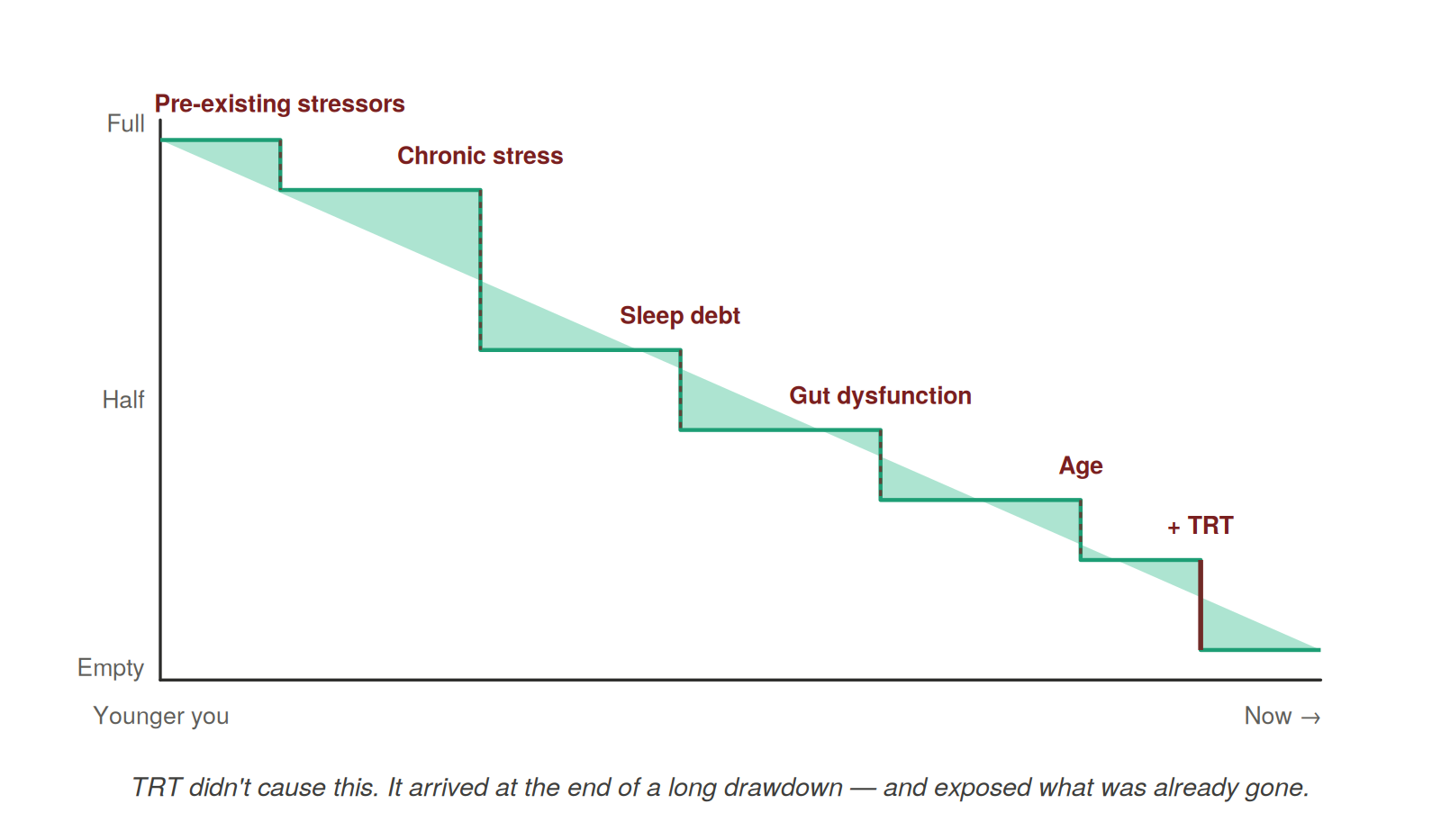
Your buffer doesn’t empty overnight. It’s usually a slow erosion. And understanding the mechanisms matters, because most guys are walking around with a depleted buffer and no idea how it got that way.
Chronic load exceeding capacity for months or years.
This is the big one. Sustained stress doesn’t just use the buffer temporarily.
It degrades the systems that produce the buffer.
HPA axis feedback regulation becomes erratic, sometimes stuck high, sometimes blunted, sometimes oscillating unpredictably.
Neurosteroid-producing enzymes downregulate.
Vagal tone erodes.
Antioxidant reserves deplete faster than they’re replenished.
Meanwhile, the raw materials your biology needs to rebuild, like magnesium, zinc, B vitamins, amino acid precursors, get burned through at high speed, especially if your diet is restricted or your gut isn’t absorbing properly.
Chronic sleep debt.
Sleep is when the buffer actually gets rebuilt - neurosteroid production, lymphatic clearance, HPA recalibration, autonomic recovery. All of it happens during deep sleep and REM.
Chronically shortchanging sleep means the buffer never fully replenishes between days.
Over months and years, the deficit compounds. This is why guys who “only” get five or six hours feel progressively worse over time, even when nothing else in their life changes.
Age.
Neurosteroid production, mitochondrial efficiency, glutathione synthesis, and NAD+ levels etc all decline as you get older.
The buffer naturally gets thinner. A 25-year-old can absorb a level of load that would flatten a 42-year-old, not because of weakness but because the biological infrastructure that produces the buffer is less robust.
And this hits right when life load is at its peak:
Career pressure
Kids
Mortgage
Relationship complexity
Gut dysfunction.
A compromised gut doesn’t just add load through systemic inflammation and immune activation. It also impairs production of the neurotransmitters and neurosteroids that make up the buffer itself. And a significant portion of serotonin and GABA precursor activity originates in the gut.
So it’s hitting you from both directions: increasing the demand on the buffer while degrading the buffer’s ability to meet that demand.
TRT itself.
As we covered above, exogenous testosterone suppresses LH, which reduces testicular pregnenolone production, one of the key inputs to your inhibitory buffer.
So TRT adds activation load while simultaneously reducing the system that’s supposed to buffer that activation. For a guy whose buffer was already slim, this can be the straw that breaks the camel’s back.
It’s not that TRT caused the problem. It’s that it exposed a depletion that was already there and made it harder for the body to compensate.
And for some men, the starting point was already compromised:
For example, a history of psychiatric medications that altered GABA receptor sensitivity or HPA axis function. Or adverse childhood experiences that wired the nervous system for threat detection before the buffer ever had a chance to fully develop.
These aren’t excuses. They’re variables. And they explain why some men arrive at TRT with a buffer that was never fully built in the first place.
Signs Your Buffer Is Gone
You don’t need a blood test to know your buffer is gone. You can feel it. You’ve probably been feeling it for a while.
You overreact to things that shouldn’t bother you.
Someone cuts you off in traffic and you spend the next 20 minutes mentally rehearsing what you'd say if you caught up with him at the next set of lights. The printer jams and you're genuinely considering whether you could pick the thing up and launch it through the window.
Your recovery window has disappeared.
A bad day turns into a bad week. A hard leg session wrecks you for three days when it used to take one. Your system has stopped recovering between stressors. It's just piling them on top of each other.
You feel wired but exhausted.
Your body is stuck in threat mode but doesn’t have the resources to do anything with that activation. You lie down at 10pm genuinely exhausted, then stare at the ceiling like a man who just drank four espressos and got audited by the IRS.
Things that used to work have stopped working.
The ashwagandha that was doing something for about a month is now doing nothing. The breathing app you paid $70 for has stopped moving the needle. The training program that used to leave you buzzing now leaves you worse than when you walked in. Your buffer was barely holding on, and the tank kept draining until there was nothing in it.
Your response to TRT itself is the biggest clue.
If your labs look reasonable, your protocol has been stable for months, you've already tried the obvious stuff, and TRT still makes you feel anxious, wired, or flat - that's not a protocol problem. That's your buffer tapping out.
It's why Chad at the gym got on TRT, felt great by week three, and hasn't thought about his protocol since. He didn't land the magic protocol. His system had room to receive it. Yours doesn't - yet.
What Happens When You Layer TRT Into a Buffer-Free Zone
Here’s how this actually plays out IRL. Your wife makes a comment about the dishes, or questions a decision you made, or is just in a bad mood about something that has absolutely nothing to do with you.
With a full buffer: you hear it, hold frame, address it if needed, maybe let it roll off, and carry on. You’re grounded. Steady. Present. The kind of energy she married you for.
With a depleted buffer: you react rather than respond. There’s no pause to work out what might be going on for her. You get defensive and snappy, before realizing that was probably not the best way to handle things.
With no buffer and testosterone amplifying every signal your nervous system receives? That same comment hits like a personal attack. You either fire back with something disproportionate, something shitty, or you shut down completely and stew about it for hours.
The thing you were supposed to absorb and move past now runs your entire evening.
You’re not showing up as the stable, masculine presence you want to be. Now there are two people in the house who can’t regulate, and the whole dynamic shifts.
She doesn’t feel safe. You don’t feel like yourself.
And you’re both wondering if the low T symptoms were better than dealing with this version of you.
But none of this is a testosterone problem. It’s a buffer problem.
Rebuilding the buffer underneath this - in the right order, without blowing up the rest of your life - is the work The Capacity Code is built around. Eight weeks, structured, application only.
Or keep reading: the next section explains the mechanism.
Why Your Buffer Determines Whether TRT Works
When exogenous testosterone enters your system, it doesn’t just raise one number on a lab panel. It produces a cascade of activating effects, each of which adds load. It:
Modulates central dopaminergic and noradrenergic signalling, which can increase activation in men whose inhibitory systems are depleted.
Can increase sympathetic activation, particularly in men whose autonomic balance is already tilted toward threat.
Stimulates erythropoiesis, thickening the blood and increasing cardiac workload.
Increases total metabolic demand as it drives protein synthesis, tissue maintenance, and higher caloric throughput.
Affects the neurosteroid milieu, particularly allopregnanolone, through its effects on precursor availability and 5α-reductase substrate competition.
Aromatises to estradiol, which in fluctuating or excessive amounts can produce its own activation issues for some men.
Every one of these is a form of biological load, which individually might be manageable. Stacked together, they represent a major increase in what your system has to process.
In a system with a manageable baseline load and a healthy buffer, the activation is balanced by inhibition. The drive is balanced by calm. That’s what TRT is supposed to feel like.
In a depleted system, the activation shows up but there’s nothing on the other end to catch it.
The inhibitory systems are tapped out.
The vagal brake is too weak.
The neurosteroids aren’t there.
The HPA axis is already a mess.
How to Start Rebuilding Your Buffer
Most guys try to treat buffer rebuilding like another protocol. “Give me the stack. Give me the list.”
Then they layer everything in at once and end up adding load to a system that already can’t handle what it has.
The practices below work. But pace and sequence matter more than the components.
Pick one or two and hold them long enough to move the needle. Then add the next.
Here are a few examples of practices that, when added at the right pace and in the right order, can have a significant impact on rebuilding your buffer:
Resonance breathing.
Least sexy, arguably the most important. Breathing at roughly 5.5 breaths per minute, (about a 5.5-second inhale and 5.5-second exhale). At this frequency, your breathing syncs with your baroreflex's natural resonance frequency and directly strengthens vagal function. Ten to fifteen minutes, two to three times a day.
The research on slow-paced breathing and HRV improvement is as solid as anything in this space2. This isn’t meditation. It’s a physiological intervention that builds vagal tone the way reps build muscle.
This was one of the most impactful practices for me when I was still very ill and really struggling. I did 15 minutes, 3x a day and noticed a difference in about a week.
Sleep.
You’ve probably already addressed the obvious sleep disruptors (caffeine timing, screens, basic environment) in the load reduction phase. Good.
Now understand what sleep is actually doing for your buffer: deep sleep and REM are when neurosteroid production happens, when the HPA axis recalibrates, when autonomic recovery occurs, and when the glymphatic system clears metabolic waste from the brain3.
While you’re rebuilding, sleep is the priority. If you aren’t consistently getting seven to eight hours, almost nothing else on this list gains traction.
The Safe and Sound Protocol (SSP).
Most guys probably haven’t heard of this one, but it’s one that moves the needle pretty reliably for men who’ve tried everything else.
SSP is an evidence-based auditory therapy developed by Dr. Stephen Porges4 (the neuroscientist behind Polyvagal Theory) that works by stimulating the vagus nerve through specially filtered music delivered via headphones.
It targets the neural circuits that govern how your nervous system distinguishes safety from threat. These are the same circuits that determine whether testosterone-driven activation feels like drive or feels like anxiety.
SSP was the missing piece that finally shifted my sleep and digestion when nothing else touched it. It was so impactful for me that I got certified as an SSP practitioner myself and have used it successfully with over 100 clients.
It’s not a magic bullet (it works best after load has been reduced and the system has some room to respond) but in my experience, it’s one of the most effective tools for expanding the window of tolerance that lets TRT actually do its job.
Note that SSP requires a trained practitioner and structured titration. It’s not something you can download and DIY. Learn more about the SSP.
Mindful walking as a regulation practice.
If you reduced your training volume during load reduction, you’re probably already walking more.
Now make some of those walks into deliberate buffer-building practice. No headphones, podcasts, or phone.
Twenty to thirty minutes of gentle bilateral movement combined with natural light exposure and low sensory input. This is one of the most effective parasympathetic activators available.
Morning sunlight within 30 minutes of waking.
Early morning light sets your circadian clock and supports a healthy cortisol awakening response. Cortisol is supposed to spike in the morning and taper through the day.
When that rhythm breaks, everything downstream suffers: sleep, energy, mood, stress tolerance.
Ten to fifteen minutes outside, no sunglasses. Simple, free, and it makes everything else on this list work better.
Targeted gut repair.
In the load reduction phase, you simplified your diet and removed inflammatory triggers.
The gut and the nervous system are directly connected via the vagus nerve. When your gut lining is compromised, it sends alarm signals to your brain around the clock, draining the buffer you’re trying to rebuild.
And the gut is where a significant portion of your neurotransmitter precursor activity originates - the raw materials your buffer is made from.
Targeted repair means specific interventions, tailored to your exact situation. Among other things, these might include:
A binder like Enterosgel to mop up endotoxins.
Zinc l-carnosine to support gut lining integrity.
A butyrate-producing probiotic like clostridium butyricum to restore barrier function and motility.
And in some cases a structured approach to identifying and reintroducing the foods you eliminated.
This isn’t “eat more sauerkraut and hope for the best.” It’s precise, and getting it right matters, which is why I walk clients through this step by step in The Capacity Code rather than just handing them a supplement list.
Deliberate low-stimulation windows.
When your buffer is depleted, your system craves stimulation as a compensatory mechanism. So you scroll. You can’t sit in a waiting room for four minutes without reaching for your phone like it’s an oxygen mask. You’re 40 minutes deep in videos of hydraulic presses crushing things and you can’t explain how you got there.
This isn’t a willpower problem. It’s a nervous system that has forgotten what baseline feels like because it’s been running on dopamine hits and cortisol for months.
And every high-intensity dopamine spike is a tiny withdrawal from an already overdrawn account.
The rebuild requires the opposite: intentional periods where your nervous system gets to exist without input.
Eat a meal without a screen.
Sit on your porch for ten minutes without your phone.
Drive without a podcast.
Let your brain be bored.
This is how your reward system recalibrates its baseline upward. Not by adding a better dopamine source, but by giving it enough silence to remember where zero actually is.
Close one open loop.
Unresolved psychological stressors, like the conversation you’ve been avoiding, the decision you keep deferring, the dead bedroom that’s destroying your soul, or the thing you said three weeks ago that you haven’t addressed, drain your buffer around the clock.
They run in the background like apps you forgot to close, consuming resources whether you’re thinking about them or not.
You don’t need to resolve everything. Pick one. The one that’s been sitting on your chest the longest.
Have the conversation.
Make the decision.
Send the email.
Write the thing down and commit to addressing it this week.
Closing even one open loop frees up buffer capacity that’s been silently haemorrhaging for weeks or months.
Most guys are surprised by how much lighter they feel after doing something they’ve been avoiding.
The Uncomfortable Truth About Rebuilding Your Buffer
No guy on X or Insta has ever posted a shirtless mirror selfie with the caption “Day 14 of sitting quietly and breathing. Feeling nothing yet. Trusting the process.”
It doesn’t make for good content.
Most men believe doing less is weakness. That if you’re not grinding, you’re losing ground.
Except the strongest men in history didn’t operate that way. And since every man alive has thought about the Roman Empire at least twice this week, let’s go there.
Marcus Aurelius - Roman Emperor, commander of armies, arguably the most powerful man on earth in his day - didn’t just rule.
He regulated.
He trained hard. Wrestling, boxing, horseback riding. He also journaled every morning before his duties began, carved out stillness during the day and time for reflection at night.
Morning regulation, physical discipline, afternoon stillness, evening reflection.
Every single day, for the better part of a decade. While managing a pandemic, commanding wars on the frontier, and holding together the largest empire on earth.
We know those journals today as the Meditations.
He understood that protecting his buffer was as serious as any military campaign. Without it, nothing else worked.
The men who rebuild their buffers fastest do the same.
They pick a small number of the right things and make them non-negotiable, whether they feel like Instagrammable progress or not.
They balance action with recovery. Consistently. Even when it doesn’t feel like anything is happening.
The man who changes his protocol every three weeks, rotates supplements monthly, and jumps to the next fix every time a forum post spooks him?
That’s not optimization. That’s a nervous system in survival mode looking for escape - not a man building something.
And every change resets the clock on the very stability his system is desperate for.
Where You Go From Here
Reducing load and rebuilding your buffer is two-thirds of the missing 40%. No protocol adjustment, no AI tweak, no supplement stack will ever touch it.
But understanding this and actually doing it are two very different things.
Most guys reading this will nod along, try resonance breathing for four days, half-implement morning sunlight, lose momentum by week three, and three months from now they’ll be back on Reddit posting their labs again wondering why nothing’s moving.
That’s not a knowledge problem. It’s an implementation problem.
I built The Capacity Code to solve exactly this. The framework you’ve just read, sequenced properly, coached, and done with structure instead of guesswork. Eight weeks, four phases, small cohorts.
Application only. I filter for fit.
Sah, R. & Geracioti, T.D. (2013). Neuropeptide Y and posttraumatic stress disorder. Molecular Psychiatry, 18, 646-655. PMC4749915
Lehrer PM, Gevirtz R. Heart rate variability biofeedback: how and why does it work? Front Psychol. 2014 Jul 21;5:756. doi: 10.3389/fpsyg.2014.00756. PMID: 25101026; PMCID: PMC4104929.
Xie, L., Kang, H., Xu, Q., Chen, M. J., Liao, Y., Thiyagarajan, M., O’Donnell, J., Christensen, D. J., Nicholson, C., Iliff, J. J., Takano, T., Deane, R., & Nedergaard, M. (2013). Sleep drives metabolite clearance from the adult brain. Science, 342(6156), 373–377. https://doi.org/10.1126/science.1241224
Kawai H, Kishimoto M, Okahisa Y, Sakamoto S, Terada S, Takaki M. Initial Outcomes of the Safe and Sound Protocol on Patients with Adult Autism Spectrum Disorder: Exploratory Pilot Study. Int J Environ Res Public Health. 2023 Mar 9;20(6):4862. doi: 10.3390/ijerph20064862. PMID: 36981773; PMCID: PMC10049251.