Expanding Your Capacity: The Final Step to Actually Thriving on TRT.
The final piece of the missing 40%. How to go from surviving on TRT to actually thriving on it.

There’s a moment that every man in this process hits, and it usually catches him completely off guard.
You’re standing in the kitchen on a Saturday morning.
The kids are being loud.
Your wife is telling you about something that happened with her friend (a story you’ve heard a version of before).
There’s a pile of laundry on the counter that nobody’s touched for days.
You slept six and a half hours because one of the kids woke you up at 3am.
And you’re fine.
Not faking it like a game show host with a hangover. Not white-knuckling through it. Just... fine.
Present. Maybe even enjoying it.
You pour yourself a coffee - because you want one, not because you’ll cease to function without it.
You wrestle with the dog for a minute.
The laundry can wait.
It’s a nothing moment, on an entirely average Saturday morning.
Except three months ago, that exact scene - same kitchen, same Cap’n Crunch on the floor, same wife mid-story - would have sent you spiralling. You would have snapped, shut down, or disappeared into a doom scroll pretending you hadn’t heard any of it.
Your wife would've stopped making eye contact. The whole day would've been on fire by 7:15am.
The difference isn’t that your life got easier. It’s that your container got bigger.
That’s capacity.
The lived, felt experience of being a man whose system can actually handle his life.
If you’ve followed this article series, you’ve learned what it means to reduce your load and rebuild your buffer. Those were the first two moves of the missing 40% - the part of the TRT equation that nobody talks about.
This final piece is about expanding your capacity: taking everything you’ve built and turning it from another recovery project into a permanent way of operating.
Let’s get into it.
What Expanding Capacity Actually Means
Load reduction was subtraction: Closing the taps that were draining your system.
Buffer rebuilding was restoration: Refilling the tank and repairing the systems that keep it full.
Expanding capacity is growth: It’s about making the tank bigger.
And we don’t make the tank bigger by adding more, or by pushing harder - but by gradually and strategically increasing what your system can handle without tipping over.
Your nervous system adapts the same way muscle does. Manageable challenge. Recovery. Slightly more resilient next time. Do that consistently over weeks and months, and the man who couldn’t handle a bad night’s sleep without it ruining his whole week starts taking on hard days without blinking.
That’s what expanding capacity actually is. Not a mindset shift, but a measurable, physiological change in how much stress your biology can process before it produces symptoms.
Vagal tone improves.
HPA axis gets better at spiking cortisol when it’s needed and shutting it off when it’s not.
Neurosteroid production normalizes.
The buffer that used to drain instantly at the first sign of stress can now cope with a stressful week.
And here’s where we come back to TRT:
Since testosterone is an activating hormone that amplifies whatever state your system is already in, a bigger tank doesn’t just mean you handle life better - it means TRT finally gets converted into drive, confidence, and recovery instead of anxiety and overstimulation.
But (and this is the part most guys get wrong) it only works if you don’t bulldoze the foundation you just laid. The process is gradual, sequential, and frankly boring. Which brings us to the practical side.
What Most Guys Are Getting Wrong. Very Wrong.
If you’ve started on some load reduction and buffer work, you’re probably already feeling noticeably better. Maybe significantly better. And that’s exactly where most guys make the mistake that sends them right back to where they started.
They floor it.
The moment they feel even the vaguest whiff of an improvement, it’s back to:
Six training sessions each week.
New supplements by the handful.
OMAD.
Cold plunges every morning.
They’re feeling good momentarily, so they pile it all back on. Then within two or three weeks they’re anxious, fatigued, and crashed out again, genuinely wondering what went wrong.
What went wrong is they treated the first sign of improvement as the end result instead of the beginnings of the foundation - and cratered all their progress.
If I had a dollar for every client I’ve seen do this I’d be retired and surfing year-round in Pavones already.
Your buffer at this stage is much larger, but it’s new. Think of it like a freshly healed bone. It’s functional, but it isn’t ready for full impact.
Load it too fast and it doesn’t get stronger, it re-fractures. And the second time around, the healing may take longer because your system now has to recover from the setback on top of the original work.
This is why expanding capacity takes time and requires a strategy.
You don’t wake up one Tuesday and declare yourself fixed. You methodically, gradually, boringly expand what your system can handle - one input at a time - and give it enough time to actually adapt before adding the next thing.
The 90% Rule
Here’s something that will either relieve you or terrify you, depending on how deep your optimisation habit runs.
100% doesn’t exist.
There is no version of this where every day is a 10/10. No protocol, no lifestyle, no program, and no amount of capacity building will eliminate bad days, rough patches, poor sleep, or the occasional week where everything feels like shit. That’s not a failure of the process. That’s life.
What changes is the ratio and the recovery.
The man with no capacity is lucky to have two or three good days a month and spends the rest in survival mode.
The man with capacity has mostly good days, occasional bad ones, and recovers from setbacks in hours or days instead of weeks.
The bad days don’t compound, and they don’t define the week.
90% means:
Most days you feel good enough.
Your baseline is solid.
Training works.
Sleep is restorative.
TRT is finally doing its job.
You’re present at home and functional at work.
And when a hard day arrives, you handle it without the rest of the week collapsing.
That’s the goal. Not perfection - just a life that actually works.
What Strategic Reintroduction Looks Like (And Why Most Guys Blow It)
During load reduction, you remove things.
Supplements get stripped.
Diet gets simplified.
Training volume comes down.
Caffeine gets cut.
Hopefully alcohol, porn and cannabis went too.
Some of that needs to go permanently. Some of it is temporary - removed to give your system space to recover, not because it was inherently bad for you.
Once your buffer is rebuilt and your nervous system has genuine capacity, you can start putting things back (nope, not the gooning).
But you do it one thing at a time.
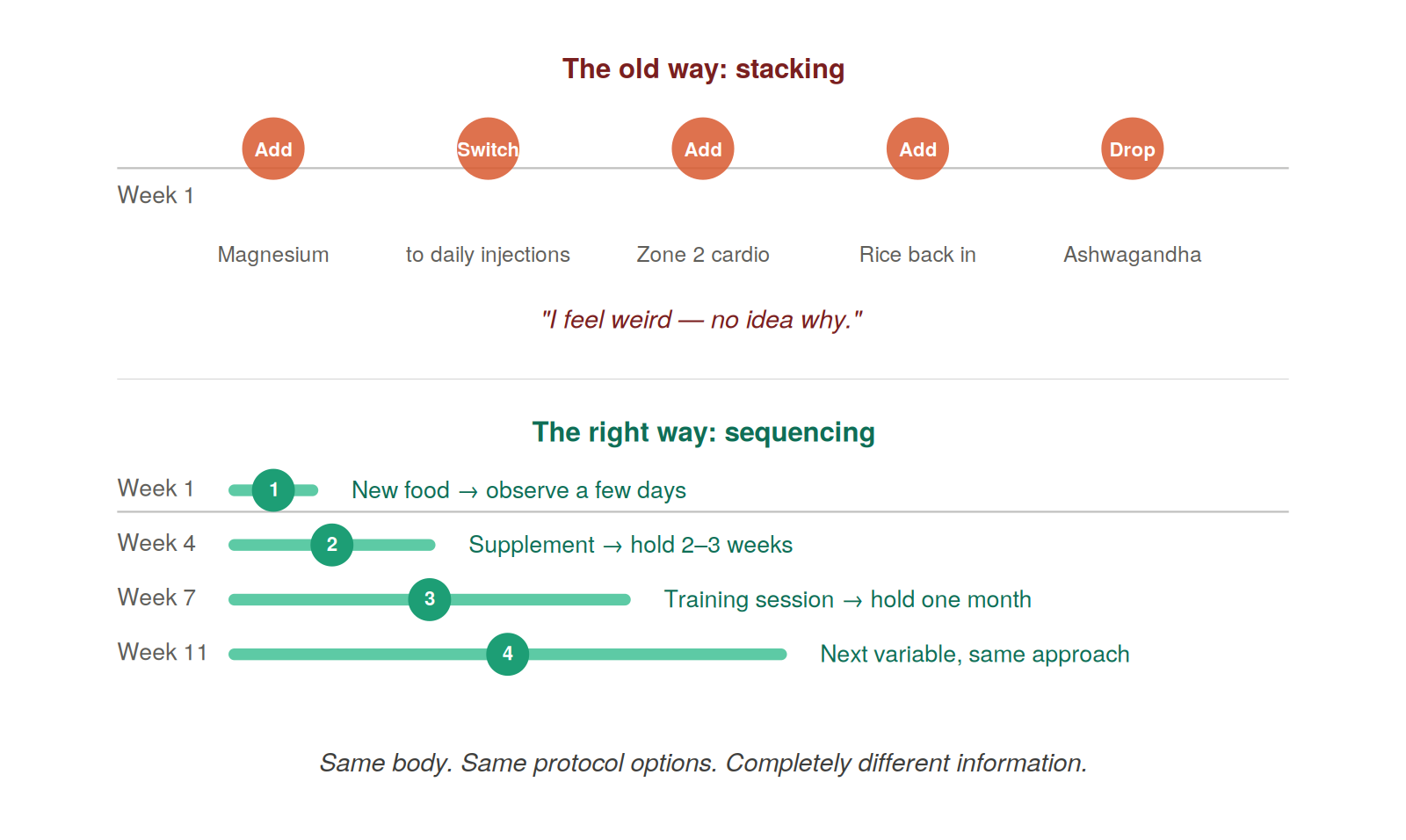
The old pattern was to change six variables in a week, feel different (better or worse), and have absolutely no idea which one caused it.
You’d post in a forum: “Started magnesium, switched to EOD injections, added Zone 2, reintroduced rice, and dropped ashwagandha - feeling weird, thoughts?” And twelve strangers with twelve different protocols would give you twelve contradictory opinions. Nobody learned anything. Least of all you.
Strategic reintroduction is the opposite of that.
You try one new food every few days.
One supplement is reintroduced over two to three weeks.
One additional training session is held for a month before considering another.
One variable at a time, with a clear observation window, so you actually know what’s helping, what’s neutral, and what still doesn’t serve you.
You’ll be surprised by what you discover.
Foods Saladino warned you about turn out to be fine when your load is vastly reduced.
Supplements Huberman swears by turn out to make you feel like trash.
Training volume that used to wreck you now produces exactly the adaptation it was always supposed to.
That’s not because the inputs changed. It’s because your capacity did, and because you finally started listening to your body.
The Capacity Code walks you through exactly this - what to remove, what to rebuild, and the order it has to happen in. Eight weeks, application only.
The Identity Shift Nobody Warns You About
Here’s one of the best (unexpected) benefits of gaining capacity: You lose interest in the things that consumed you and added to your load.
r/TRT stops luring you in.
The late-night lab analysis and Google spreadsheet habit fades.
The urge to tweak your protocol every. damn. time. you have a bad day stops.
The constant, low-grade anxiety about whether TRT has ruined your life ends.
This can feel disorienting when for months - or maybe years - your identity has been formed around being the guy who’s trying to figure out TRT.
The research.
The spreadsheets.
The forums.
The protocol changes.
The different prescribers.
It gave you a sense of control when everything else felt chaotic. It was something to do with the anxiety, even though it was making the anxiety worse.
When the anxiety lifts and the system stabilises, that identity doesn’t have a job anymore.
Congratulations. You just got your life back.
What Life Looks Like With the Full 40% in Place
So what does it actually look like when you’ve done all three - reduced the load, rebuilt the buffer, expanded your capacity?
Your TRT works. Not in a “honeymoon phase” way that fades after six weeks. In a stable, consistent, sustainable way.
The drive is there without the anxiety.
The confidence is there without the irritability.
The libido is consistent - not a roulette wheel that depends on whether you slept well or if Mercury is in gatorade.
Recovery is solid.
You’re building muscle and your body comp is shifting.
You’re calm without being flat.
You’ve got energy without being wired.
You can push hard in the gym and recover.
You can have a stressful day at work and still sleep that night.
You can have a difficult conversation with your wife and resolve it like two adults instead of exploding or shutting down.
Your mornings have a rhythm.
Not a punishing 5am routine designed to demonstrate discipline to an audience of no one, but a simple set of practices that set you up for the day. Sunlight. Breathing. A walk. Coffee because you enjoy it.
Your evenings belong to your family, or to you.
Not to Reddit. Not to doom-scrolling through r/TRT comparing your labs with strangers. Not to lying awake at 1am running mental simulations of what would happen if you switched from cypionate to enanthate.
You go to the doctor, get your bloods done, glance at the results, and move on to play pickleball.
Because your health is no longer a crisis you’re managing. It’s a background system that runs.
Remember Chad? The guy from the last article who got on TRT, felt great by week three, and never had to think about his protocol again? The guy you always assumed got lucky?
Turns out he didn’t get lucky. He just had the system you’ve now built.
The Long Game
A few things to take with you.
The practices that got you here are the practices that keep you here.
The morning anchor, the breathing, the walking, the sleep - these aren’t things you did to fix a problem and can now abandon. They’re the new operating system.
The moment you drop them because you “feel fine now” is the moment the buffer starts to gradually thin again. And by the time you notice, you’re three months back toward where you started, wondering what happened.
If you do eventually want to adjust your protocol, you’ll know you’re ready.
You’ll have been stable for at least eight weeks, you’ve implemented everything in your maintenance system, you have a specific reason based on a persistent symptom, and you change one variable at a time for four to six weeks before assessing.
That’s what real progress looks like.
And finally: the version of you that sat in that forum at midnight, heart racing, wondering if you’d ever feel normal on TRT - he’s the reason you’re here. But he’s not who you are anymore. You built something he couldn’t - and it wasn’t a better protocol or a more optimised stack. It’s a system that can actually hold the life you’re trying to build.
That’s what capacity looks like. That’s the missing 40%. And it changes everything.
What Comes Next
If you’ve been following this series from the start, you now understand why TRT isn’t working the way it should at a level that most clinics, coaches, and forums will never give you.
The 40/40/20 model.
Load reduction.
Buffer rebuilding.
Capacity expansion.
The full picture.
But understanding and implementation are very different things. And doing this work alone - without structure, without guidance, without someone who’s been through it telling you what’s normal and what’s a red flag - that’s the hard way.
I know, because I did it the hard way. And it took me years.
I built The Capacity Code so it doesn’t have to take you years.
Eight weeks. Four phases. The full framework from this series, built into a structured program with weekly coaching, accountability, nervous system tools you won’t find anywhere else in this space, and a small cohort of men doing the exact same work at the same time.
Application only. Spots are limited. I filter for fit.